
Cousin calculator: what is a second cousin, or a cousin once removed?
Is your cousin's child your cousin, your niece, or something else? Choose where your common ancestor is and the calculator gives you the name of the relationship.
The common ancestor is the person you both descend from. With a first cousin it is your grandparents; with a second cousin, your great-grandparents. If one of you descends from the other (a grandchild, a great-grandmother), choose “Me” or “Them”.
What each relationship means
It all depends on how many generations there are from each of you up to the common ancestor:
- Siblings share the same parents.
- First cousins share the same grandparents: your parents are siblings.
- Second cousins share the same great-grandparents: your parents are first cousins.
- Third cousins share the same great-great-grandparents.
- Great-uncle or great-aunt: your grandparent's brother or sister. You are their great-nephew or great-niece.
What “removed” means
“Removed” is used when the two of you are in different generations. Once removed means one generation apart, twice removed two generations apart. So your first cousin's child is your first cousin once removed, and you are their first cousin once removed too. Your parent's first cousin is also your first cousin once removed.
Your children and your first cousin's children, who are in the same generation, are second cousins.
Family relationship chart
Find the common ancestor as seen by you in the row, and as seen by the other person in the column. The cell shows what that person is to you (for women: aunt, niece, granddaughter…).
| You ↓ · the other person → | Parents | Grandparents | Great-grandparents | Great-great-grandparents | 3rd great-grandparents |
|---|---|---|---|---|---|
| Parents | brother | nephew | great-nephew | great-great-nephew | 3rd great-nephew |
| Grandparents | uncle | first cousin | first cousin once removed | first cousin twice removed | first cousin 3 times removed |
| Great-grandparents | great-uncle | first cousin once removed | second cousin | second cousin once removed | second cousin twice removed |
| Great-great-grandparents | great-great-uncle | first cousin twice removed | second cousin once removed | third cousin | third cousin once removed |
| 3rd great-grandparents | 3rd great-uncle | first cousin 3 times removed | second cousin twice removed | third cousin once removed | fourth cousin |
Degrees of kinship
Many legal systems count the degree of kinship by counting the generations from one person up to the common ancestor and then down to the other. Parents and children are related in the 1st degree; grandparents and siblings in the 2nd; aunts, uncles, nieces and nephews in the 3rd; first cousins in the 4th. The calculator shows this number too.
Your tree, with everyone's relationship
In Ramo you don't have to work anything out: turn on “Relationship” and every card on the tree says how that person is related to the main person (father, aunt, first cousin, niece, brother-in-law, son-in-law…), including in-laws.
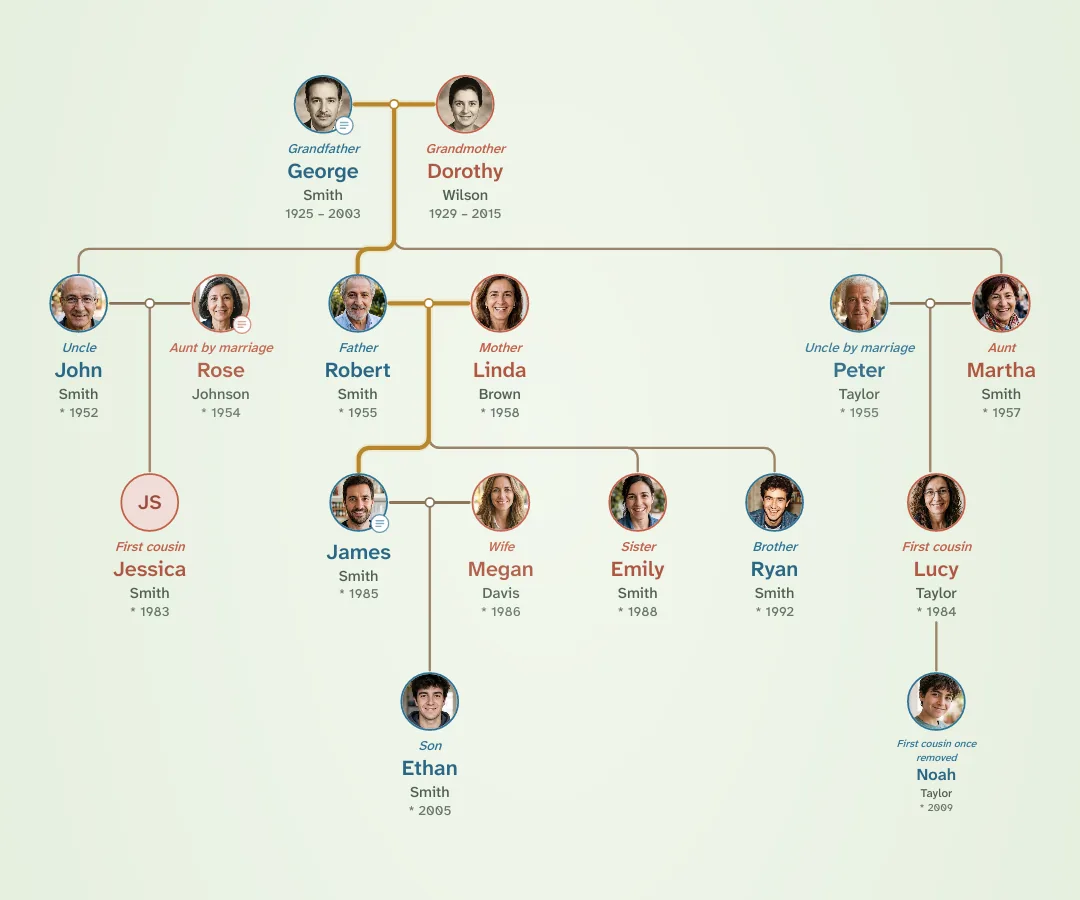
It's free to start, and you can share the tree as a PDF with the whole family so everyone can see where they fit.
More guides